
The most important parts of a ring are often the parts nobody notices
When someone looks at an engagement ring, the first impression is usually immediate:
The diamond catches the light.
The design feels elegant.
The piece creates an emotional response.
That moment matters.
But a master jeweller knows something deeper:
The true quality of a ring is often revealed in the details that are never photographed.
The underside.
The transitions.
The finishing.
The structure.
The decisions made when nobody is looking.
Because exceptional craftsmanship is not about adding unnecessary decoration.
It is about making every part of the piece purposeful.
The Difference Between Looking Good and Being Well Made
A ring can look beautiful from a distance.
A carefully crafted ring remains beautiful when examined closely.
A trained eye begins to notice:
How does the metal flow?
Are the proportions balanced?
Are edges refined?
Are surfaces properly finished?
Does every component appear intentional?
The best jewellery does not rely only on visual impact.
It rewards closer inspection.
The Underside of the Ring: Where Craftsmanship Lives
Many people never see the underside of a custom engagement ring.
A jeweller often looks there first.
Why?
Because hidden areas reveal decisions.
A well-made ring may include:
carefully finished galleries,
smooth transitions,
thoughtful support structures,
clean metalwork.
These areas affect:
comfort,
durability,
maintenance,
the overall integrity of the design.
The underside is where a maker has the freedom to cut corners.
A true craftsman does not.
The Gallery: Beauty From Every Angle
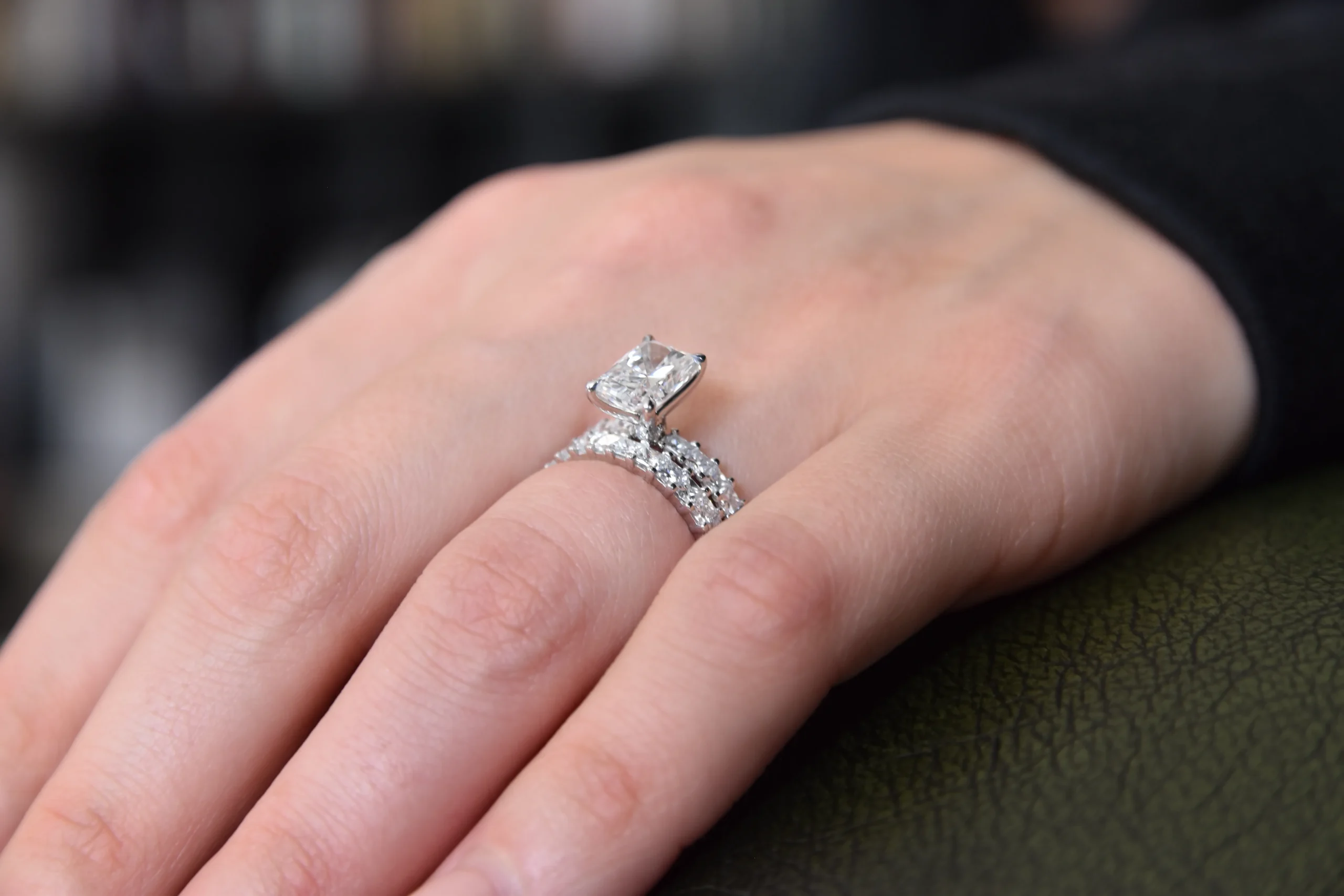
The gallery is the structure beneath the centre stone.
It serves several purposes:
supporting the gemstone,
allowing light access,
adding strength,
creating visual balance.
A poorly considered gallery can make a ring feel heavy or awkward.
A thoughtfully designed gallery can make a ring appear lighter and more elegant.
It is a perfect example of invisible craftsmanship.
Metal Transitions: The Places That Reveal Skill
Exceptional jewellery has continuity.
One part appears to naturally become another.
Look at:
where the shoulders meet the setting,
where pavé transitions into plain metal,
where a shank changes shape,
where different design elements connect.
These areas require precision.
A harsh transition can make a ring feel assembled.
A refined transition makes it feel created.
Surface Finishing: The Final Expression of Quality
Polishing is not simply making metal shiny.
Finishing involves controlling:
reflections,
texture,
edges,
surfaces.
A well-finished ring has:
smooth movement between surfaces,
intentional contrast,
refined edges.
Under magnification, finishing becomes one of the clearest indicators of craftsmanship.
Symmetry and Alignment
The human eye is sensitive to balance.
Even when someone cannot explain why a ring feels right, symmetry often plays a role.
A jeweller considers:
alignment of stones,
consistency of spacing,
relationship between left and right sides,
visual weight.
Small inconsistencies can distract from the beauty of a design.
Precision creates calm.
The Importance of Proportion
A ring is a composition.
Every element has a relationship:
the centre stone,
the band,
the setting,
accent diamonds,
negative space.
Too much of one element can overwhelm another.
The goal is not maximum detail.
The goal is harmony.
The Details of Pavé Setting
Pavé is one of the most technically demanding styles of setting.
The goal is to create the appearance of continuous brilliance.
This requires:
consistent spacing,
secure stone placement,
precise metal work,
careful finishing.
A skilled setter creates a surface where the eye sees light before it sees the mechanics.
Comfort: The Craftsmanship You Feel
Some of the finest decisions in a ring are experienced rather than seen.
A beautifully made ring should:
sit naturally on the finger,
have smooth edges,
feel balanced,
avoid unnecessary bulk.
Comfort is not separate from craftsmanship.
It is evidence of it.
The Importance of Intentional Simplicity
One of the hardest things in jewellery design is restraint.
Adding detail is easy.
Knowing what to remove requires experience.
A simple solitaire engagement ring may appear uncomplicated.
But simplicity leaves nowhere to hide.
Every proportion matters.
Every line matters.
Every surface matters.
Minimal design often requires maximum precision.
What Experts Look For When Examining Jewellery
When a master jeweller evaluates a piece, they often consider:
Construction
Is the ring structurally sound?
Finishing
Are surfaces refined?
Proportion
Does everything relate properly?
Function
Will it perform well over time?
Intention
Does every element have a purpose?
The goal is not complexity.
The goal is correctness.
Why These Details Matter Years Later
A ring does not remain beautiful by accident.
Over time:
metal experiences wear,
stones require maintenance,
surfaces encounter daily life.
Thoughtful craftsmanship gives a piece the ability to age gracefully.
The hidden decisions made at the beginning determine the future of the ring.
The Lesson of True Craftsmanship
The finest jewellery often contains the least obvious work.
A perfectly aligned setting.
A smoothly finished surface.
A carefully engineered support.
A comfortable interior.
A transition that feels natural.
These details may never be mentioned by the wearer.
But they are the reason the ring continues to feel exceptional.
The Master Jeweller’s Principle
Anyone can design something that looks beautiful from across the room.
The true test is whether it remains beautiful when someone looks closer.
Exceptional craftsmanship exists in the details:
The details that are seen.
The details that are felt.
And most importantly:
The details that are never noticed because they were done perfectly.
